

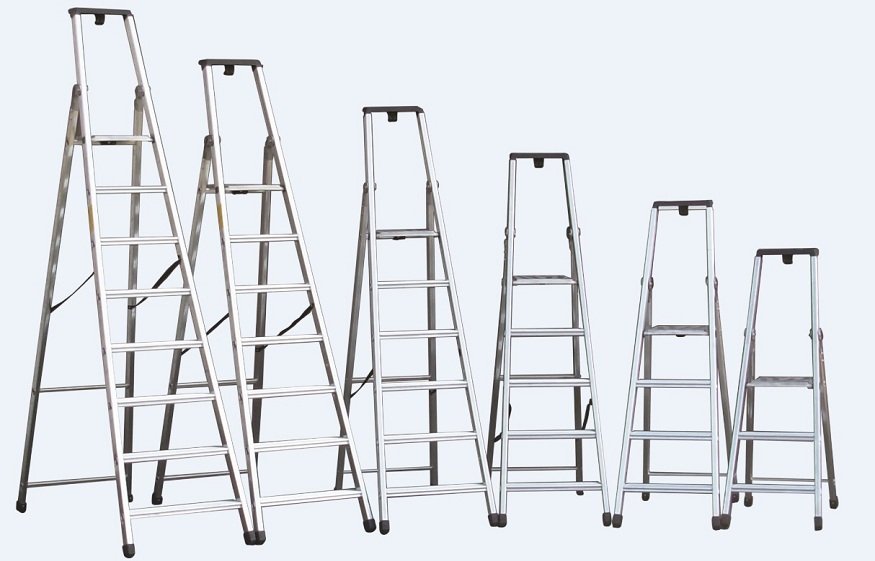
Warehouses are built around vertical space. Racking systems climb toward the ceiling, mezzanines stack storage on top of storage, and rooftop units need regular servicing. Hence, warehouse workers need a reliable way to get up and down safely, repeatedly, and without slowing operations. Off-the-shelf ladders rarely meet that challenge, which is why so many warehouse operators eventually turn to custom heavy-duty ladders that are built specifically for their facility.
Benefits of using custom heavy-duty ladders in warehouses
A typical hardware-store ladder is meant for occasional, light-duty use. Warehouse environments are the opposite. Ladders here may be climbed dozens of times a day by workers carrying tools, parts, or inventory. They’re exposed to dust, temperature swings, and sometimes corrosive or humid conditions depending on the industry. A ladder that isn’t engineered for that level of repeated stress becomes a liability rather than a convenience. Their rails flex, rungs wear unevenly, and failure points emerge faster than expected. Custom heavy-duty ladders solve this by matching the ladder’s construction, materials, and load rating to the actual conditions of the facility, rather than forcing a generic product into a role it wasn’t designed for.
No two warehouses are laid out the same way. Their ceiling heights vary, mezzanine placements differ, roof hatches sit in different spots, and racking configurations change from one facility to the next. A fixed-dimension ladder often doesn’t line up properly with these features, forcing workers to stretch, twist, or use unsafe workarounds just to reach a platform or hatch. Custom ladders are engineered to match precise site dimensions, making sure that it fits the relevant area perfectly. This is especially important for mezzanine access, roof hatch access, and crossover points between platforms, where a few inches of misalignment can turn a routine climb into a real safety hazard.
Read More: How Professional Moving Services Make Apartment Relocations Easier
Ladder-related injuries are common in industrial settings, and fixed access ladders in workplaces are subject to specific regulatory requirements. In the U.S., OSHA standards govern load capacity, rail extension height above landings, and the condition ladders must be kept in to remain in service. Ship ladders and fixed stairways used in warehouses for steep, space-limited access tend to be covered under separate standards addressing tread depth, riser height, clearance, and handrail requirements. Meeting these requirements consistently is difficult with a ladder that wasn’t designed around them from the start. Custom heavy-duty ladders can be engineered from the outset to meet or exceed load capacity requirements with correctly extended side rails, compliant tread and riser dimensions, and handrail configurations suited to the specific access point. That reduces both the risk of injury and the risk of failing a workplace safety inspection.
Read More: Vacuum Cleaners for Indian Homes: A Practical Buying Guide
Warehouses aren’t uniform spaces, and the access equipment inside them shouldn’t be treated as one-size-fits-all either. Custom heavy-duty ladders address the specific dimensions, load demands, and regulatory requirements of each facility, reducing injury risk, supporting compliance, and standing up to the wear of daily industrial use. For any warehouse where vertical access is a daily necessity rather than an occasional task, a custom-engineered ladder would be a basic requirement for safe operations.